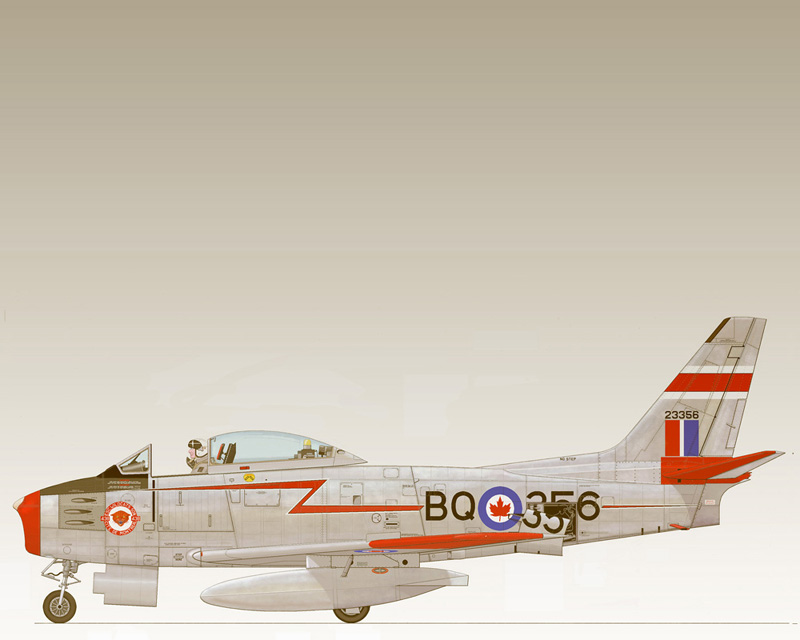
Canadair Sabre Mark 5
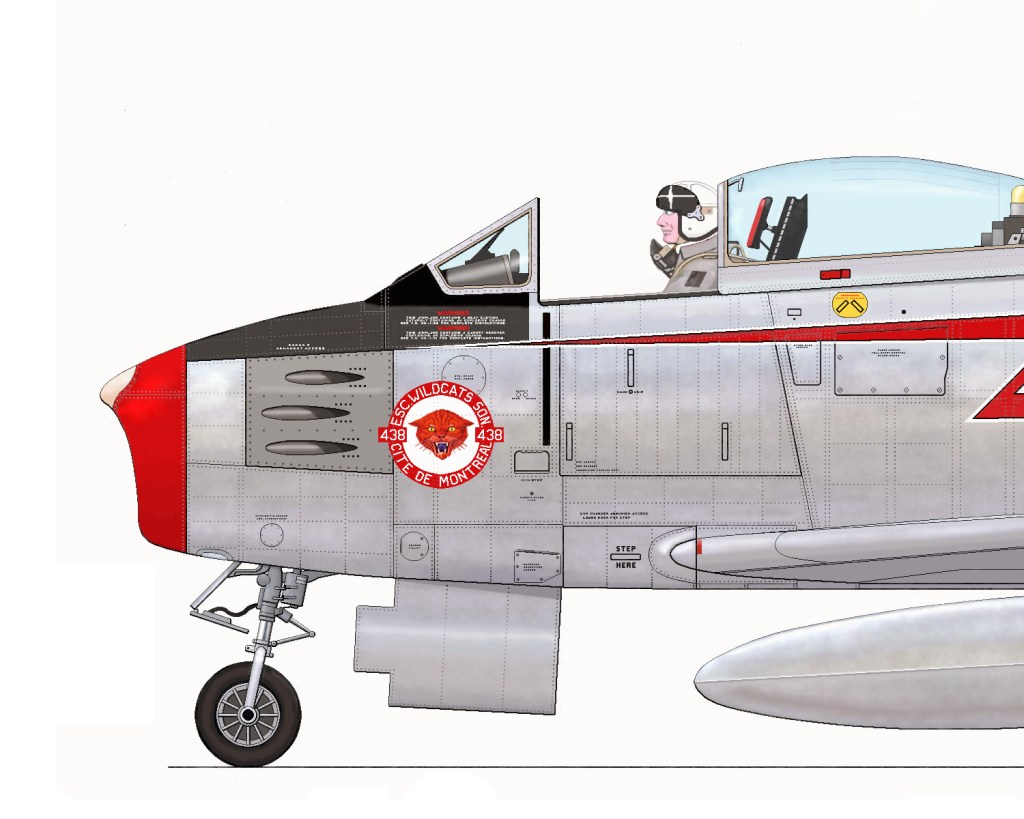
RCAF 438 Sqn. “Wildcats” based at St. Hubert, 1956 – 1958.
The Canadair Sabre Mark 5 was similar to the North American F-86F except that it was powered by the more powerful Canadian designed and built Orenda 10 turbojet engine of 6,355 lb. st.
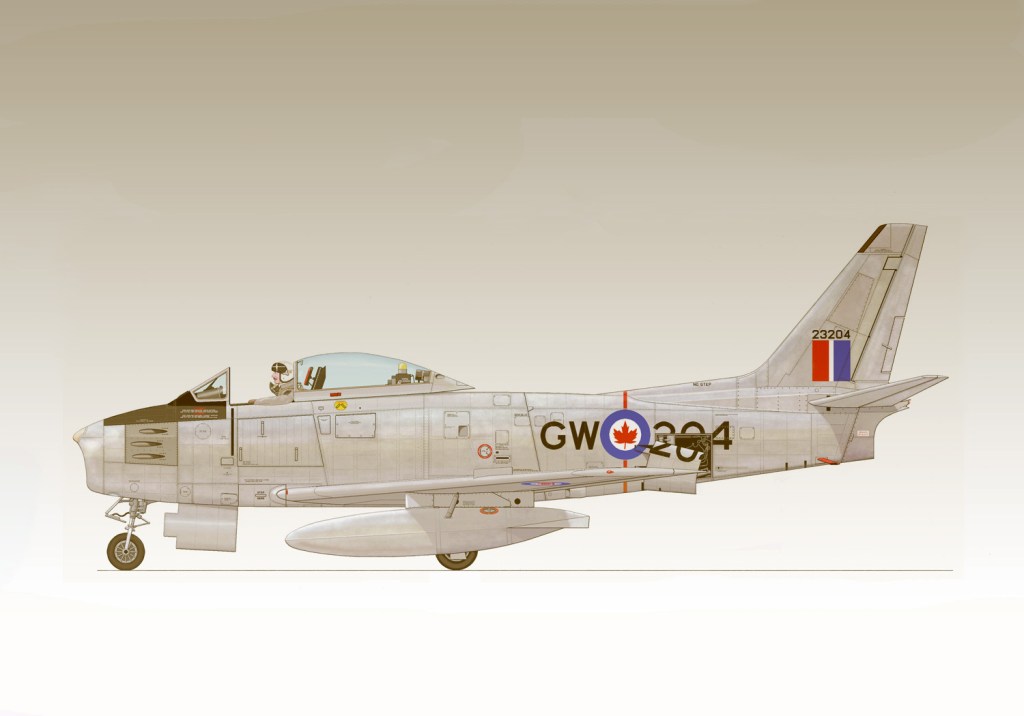
Canadair Sabre Mark 5 of 400 “City of Toronto” Sqn., RCAF (Aux.), Downsview, 1956 – 1958.
North American F-86F Sabre
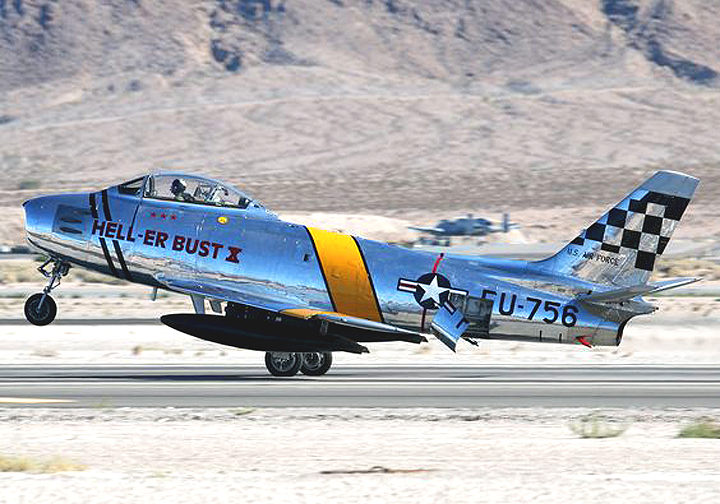
The first F-86F-1 of 1952 was powered by the J-47-GE-27 engine of 5,910 lbs. st, which raised the top speed to 693 mph and sharply increased rate of climb to 9,300 ft./min. Later F models would introduce better and stronger wings that could handle 200 gal. drop tanks.
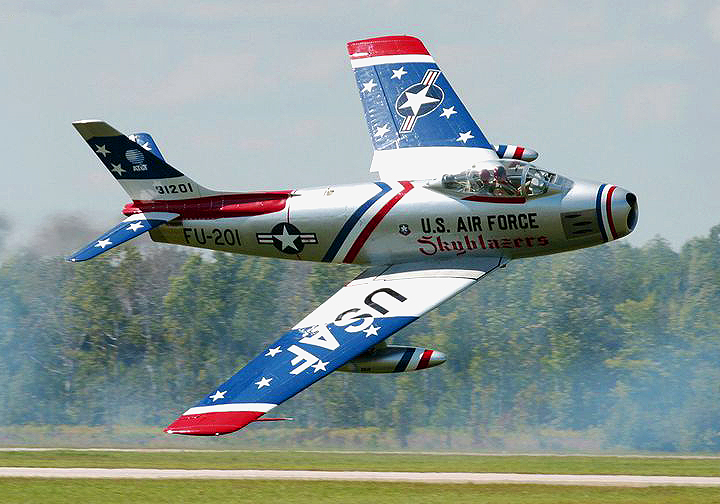
Sabre Origins
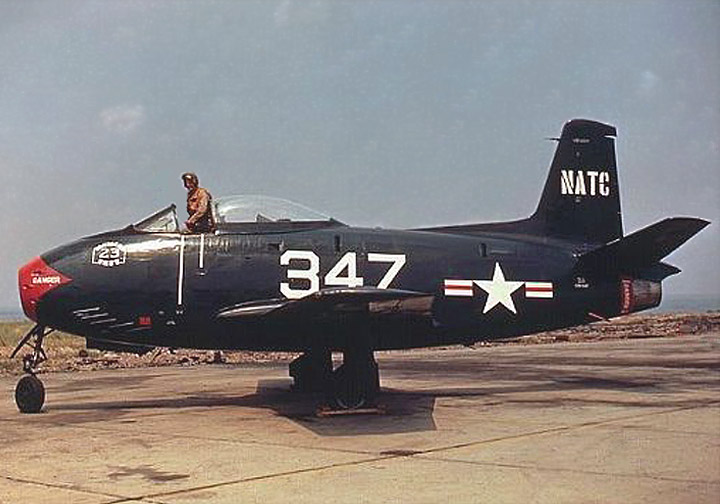
The North American FJ-1 Fury of 1946 was the grand-dad of all Sabre variants. It was basically a navalized Mustang with a jet engine, tail hook and tricycle undercarriage. Performance was disappointing, however. What was needed was a revolutionary approach to the airframe design.
Swept Wings
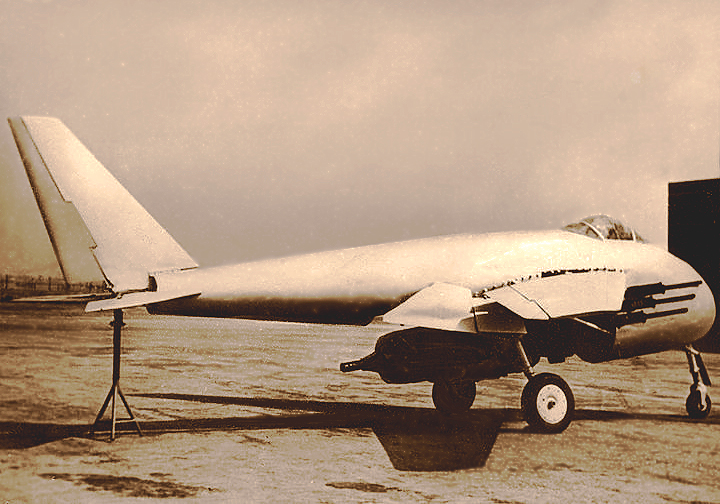
It was decided to sweep all of the flying surfaces back by 35 degrees, like the Messerschmitt P.1101 of 1944.
First True Sabre
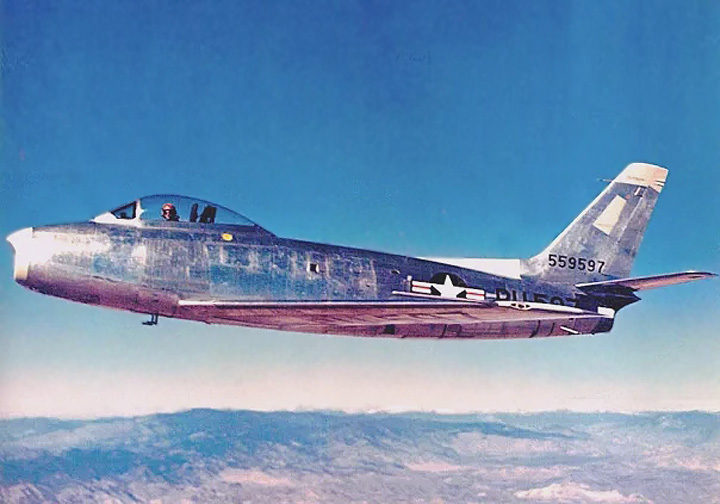
The North American XP-86 (2) of 1947 was the breakthrough result. The XP-86 (1) was a de-navalised, bare metal FJ-1. There were no guns at this stage.
Canadair Sabre Mark 1
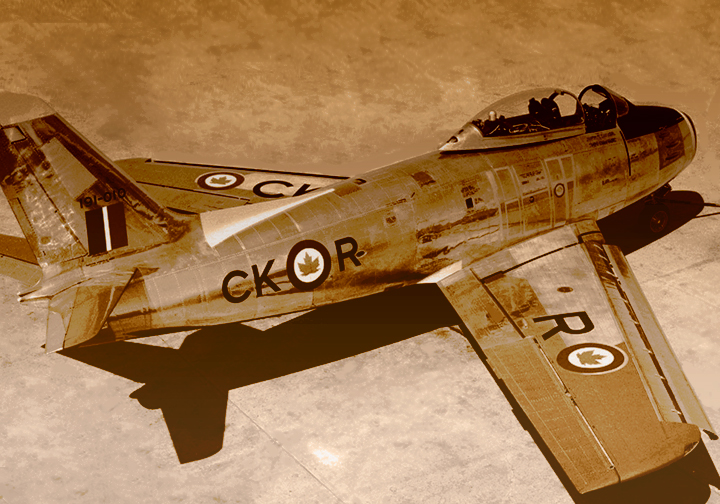
The one and only Sabre Mark 1 was an F-86A assembled from parts shipped to the Canadair plant at Cartierville, Quebec, from California. It first flew on Aug. 9, 1950, powered by a J-47-GE-7 axial flow turbojet of 5,000 lbs st. Note the conventional horizontal tail.
Messerschmitt Me 262
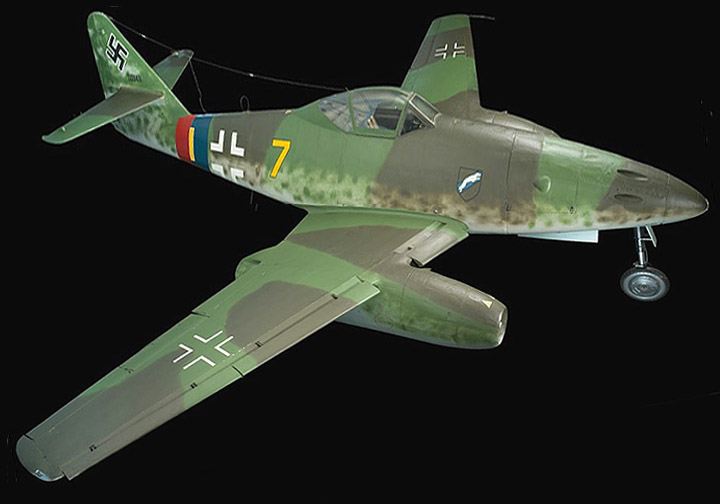
The leading edge slats on the early Sabre were copied from the Messerschmitt Me 262, and improved low speed handling by smoothing the air flow over the wing. This is the Me 262a at the National Air and Space Museum in Washington DC. The slats are shown deployed on the starboard wing. They were designed to come out automatically before the aircraft reached stalling speed.
All-flying Tail
Introduced on the F-86E and Canadair Sabre Mark 2, the all-flying tail was an innovation that allowed the Sabre to defeat the MiG-15 in the Korean War. A moveable horizontal stabilizer reduced buffeting and increased controllability at low speed approaching the stall, and also at high end trans-sonic speed. The problem of control reversal near the sound barrier was eliminated.

The New Tail in Action
This is the all-flying tail in a larger fairing in the full down position on a privately owned CL-13B (former RCAF Sabre Mark 6) during landing. Speed brakes, flaps and slats are out, allowing a landing speed of just 124 mph.
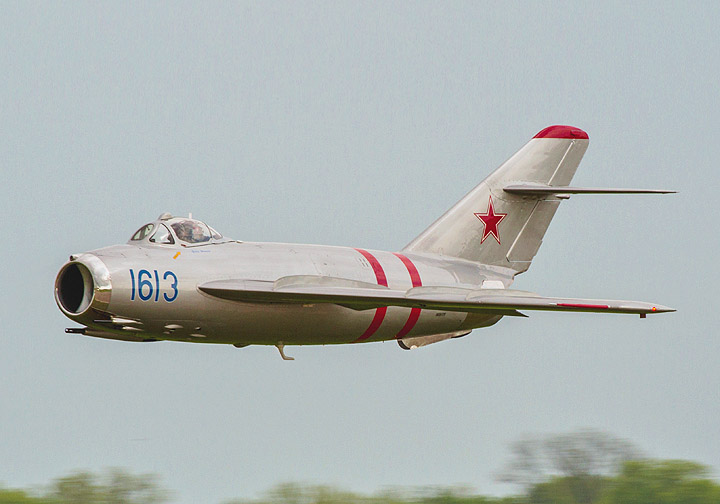
MiG-15
When the Mikoyan and Gurevich MiG-15 appeared in the skies over Korea it came as quite a shock to the USAF. The MiG was 100 mph faster than the straight wing jets such as the F-80 and F-84 of the USAF, or the Panthers of the US Navy. The MiG-15 was even faster than the F-86 and could fly higher, although later F-86E and F models were eventually able to defeat it decisively. The lighter MiG was powered by a copy of the excellent British Rolls Royce Nene centrifugal flow jet engine. The Sabre proved to be more agile though, and had a better A-1CM gun sight with AN/APG-30 radar. MiG armament was one 37 mm and two 23 mm cannon.
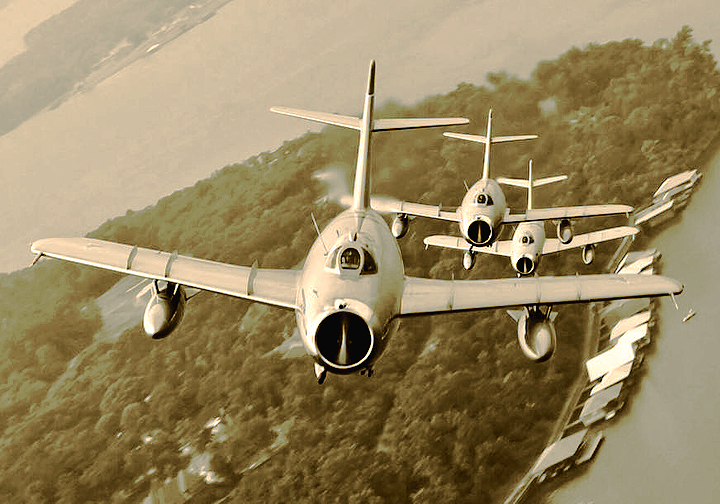
MiG-17
The improved and even faster MiG-17 first flew in 1950 and was in production by 1952. It had a longer fuselage and wings, and a more powerful engine with an afterburner. This meant that it could escape the Sabre by going vertical. However, the generous wing fences would indicate air flow issues at lower speeds. Compressibility problems were also known at higher speeds. This MiG-17 is privately owned (formerly Warsaw Pact) and has appeared at air shows in the U.S.
Sabre Armament
All Canadair Sabres were armed with six 0.50 cal. Browning M3 machine guns with a total of 1,800 rounds, and could also accommodate rockets, bombs, external fuel tanks, and even Sidewinder AAMs on four wing pylons. The guns could be harmonized, unlike the MiG’s cannon, and were faster firing. Lots of these reliable guns were left over from WW II. This Sabre Mark 5 is getting re-armed at the RCAF OTU in Chatham NB.

Rocket Firing
Sabre Mark 5 from the OTU at Chatham NB firing 3.75 in. practice rockets.
Canadair Sabre Mark 2
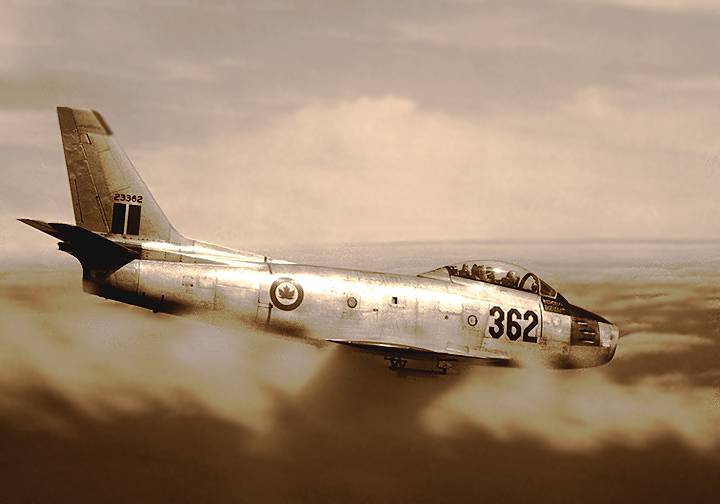
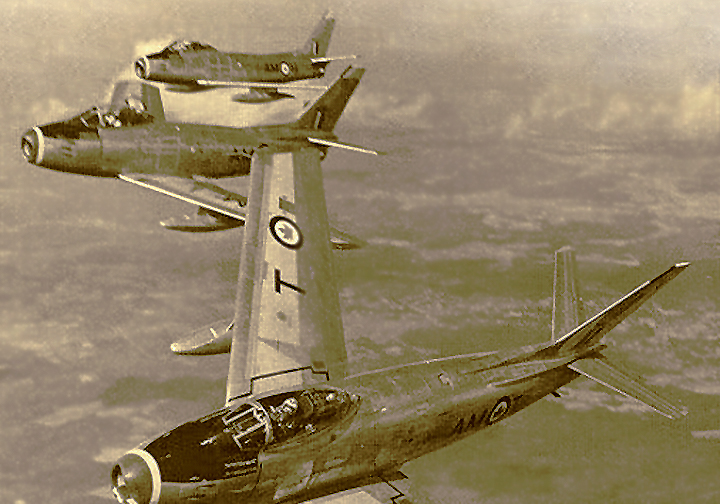
The first production model of the Canadair Sabre was the Mark 2, entering RCAF service with 410 “Cougar” Sqn. in 1951. The Mark 2 was identical to the USAF F-86E, and had the same J-47-GE-13 axial flow jet engine of 5,200 lbs. st. These 410 “Cougar” Sqn. Sabres were based at North Luffenham, UK, from 1951 to 1954. A small number of RCAF pilots on temporary duty flew the Sabre in Korea on combat missions with the USAF. Of the 350 Mark 2s built, 290 went to the RCAF and 60 went to the USAF as F-86E-6s.
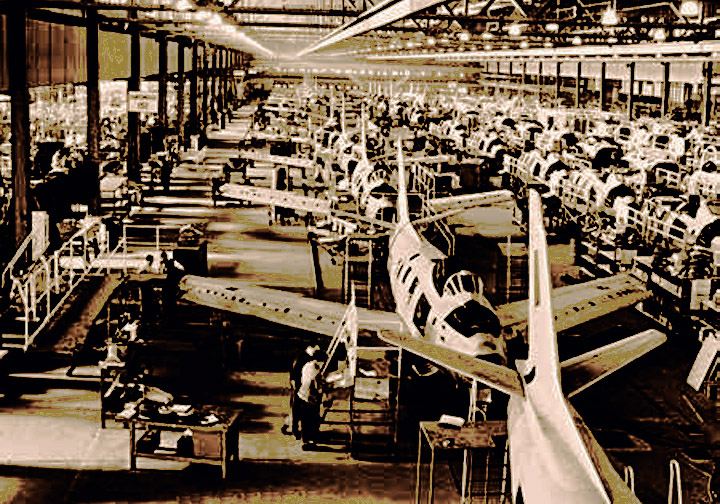
Canadair Production Line
Canadair Limited of Cartierville, Quebec, built 1,815 CL-13s (Sabres) of Mark 2 to Mark 6 versions under licence from North American during the 1950s. Canadair was owned by the General Dynamics Corporation from 1952 to 1954, and then Convair from 1954 to 1976. Convair was a subsidiary of General Dynamics. Total of all versions of the Sabre built worldwide was 9,860, making this aircraft the most produced Western jet fighter.
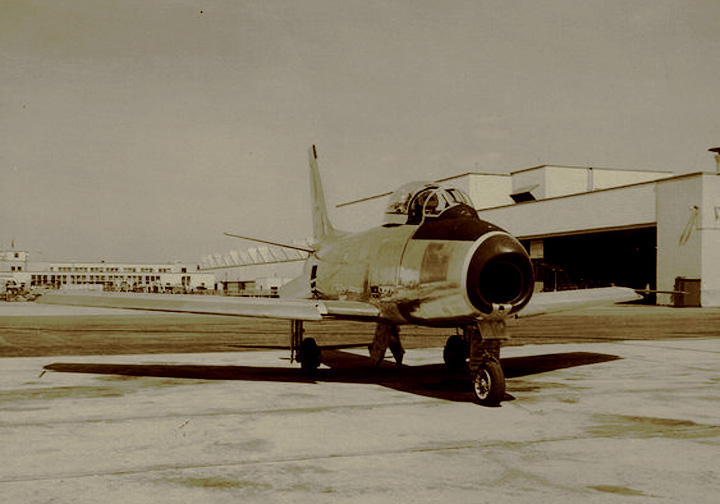
Canadair Sabre Mark 3
There was just one unarmed Sabre Mark 3 that was used as a test bed for the Orenda 3 jet engine of 6,000 lbs. st. The fuselage had to be modified to accept this slightly larger engine. The Mark 3 was borrowed by aviatrix Jacqeline Cochran to become the first woman to break the sound barrrier, May 18, 1953. She also set several new speed records with this aircraft.
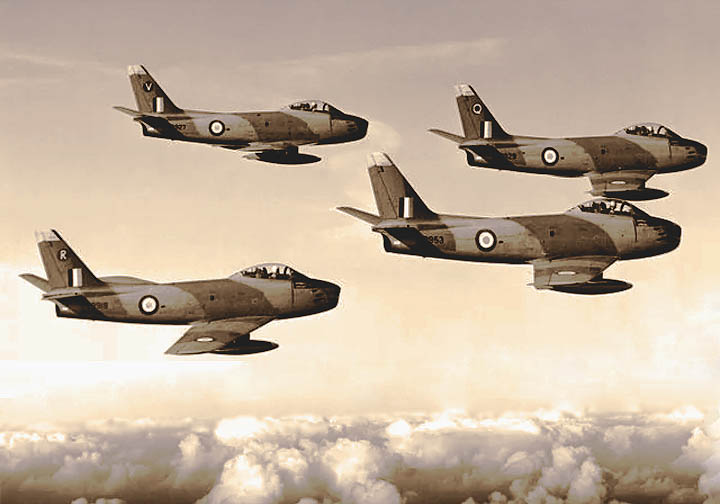
Canadair Sabre Mark 4
The Mark 4, that entered production in 1953, was a slightly improved version of the Mark 2 with better gunsight and new air conditioning. The same J-47-GE-13 engine was used. Most of the 438 built went to the RAF, and only 10 to the RCAF. The RAF had 12 Squadrons of Mark 4s, 1953 to 1956, most of them serving with NATO in Germany. When the Hawker Hunter finally entered RAF service, the Sabre Mark 4s were passed on to NATO allies Italy (179), Greece (120), and even Yugoslavia (121).
F-100 Super Sabre
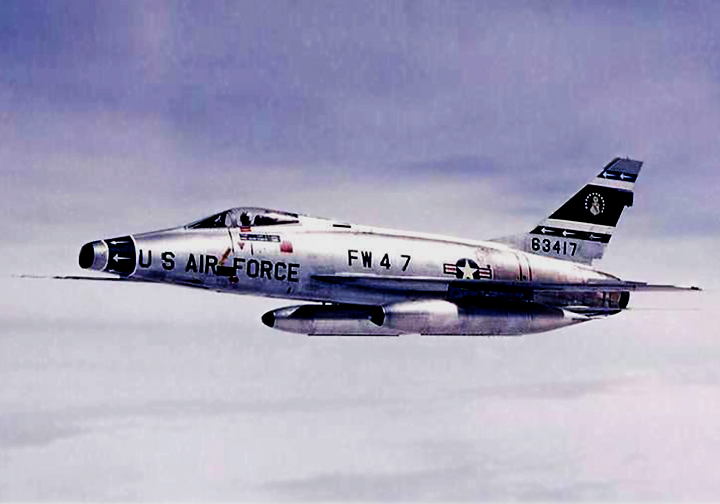
Also in 1953, North American unveiled a sleek new Sabre that was cannon armed, had an afterburner and was supersonic in level flight. Unfortunately it had a pitchup problem, or yaw instability, making it unsuitable as a dogfighter. At low airspeed it had pronounced backside tendencies caused by inertial roll coupling that could be fatal while landing. This was known as the “Sabre Dance”. Although later models had more power and longer wings and tail surfaces, the problem was never completely resolved. In Vietnam the USAF used the F-100 as a strike fighter. There is one unconfirmed case of an F-100 downing a MiG-17 in Vietnam, but normally these two aircraft did not meet in combat.
Canadair Sabre Mark 5
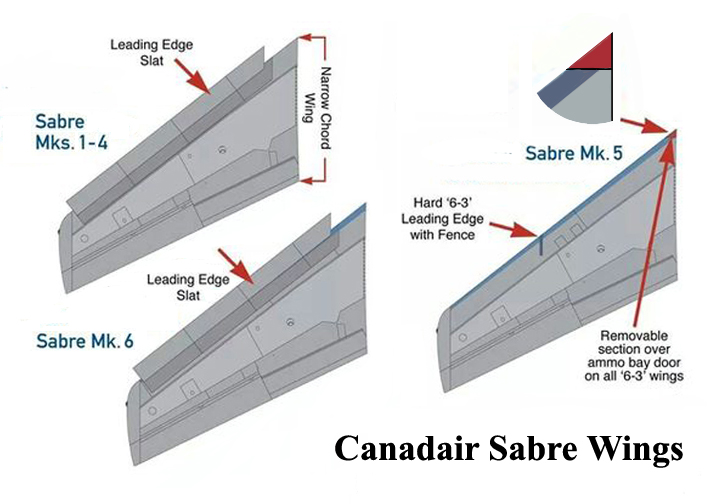
Equipped with the more powerful Orenda 10 engine of 6,355 lbs. st, the new wing and radar ranging A-4 gunsight, the Mark 5, like the F-86F-25, was faster and even more agile. Starting in 1953, 570 Mark 5s were built. The leading edge slats were deleted on this model resulting in a higher landing speed (145 mph). The Mark 5 instead had small wing fences on the leading edge.

The ‘6-3’ Wing
The new more tapered Sabre Mark 5 hard wing was wider by 6 inches at the root and 3 inches at the tip. This necessitated the addition of a small removable triangular piece so that the same ammo bay door could be used. Introduced by North American in 1952 on the F-86F-25, the ‘6-3’ wing was also retrofitted as a kit to F-85Es and ex-RAF Mark 4s. By delaying the trans-sonic buffet, the new wing allowed Sabre pilots more “usable Gs” at high Mach numbers and altitudes. The Sabre could now turn inside all MiGs, including the supersonic MiG-19 and even the MiG-21.
Luftwaffe Mark 5 Sabres
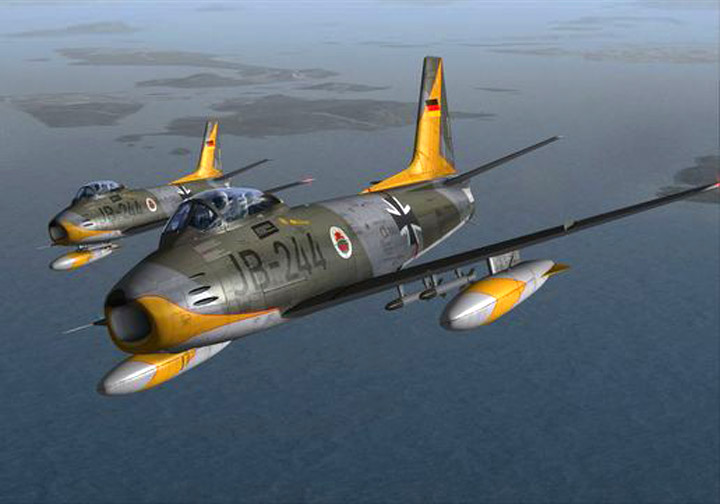
In 1957, the newly reformed Luftwaffe of the Federal Republic of Germany (West Germany) obtained 75 Canadair Sabre Mark 5s. These are from JG 72 based at Leck. Unlike the RCAF Sabres, German Mark 5s were armed with AIM-9B Sidewinders as well as guns. In combat any fleeing MiG could have had one of these heat seekers flying up its tail pipe.
The Classic Dogfight
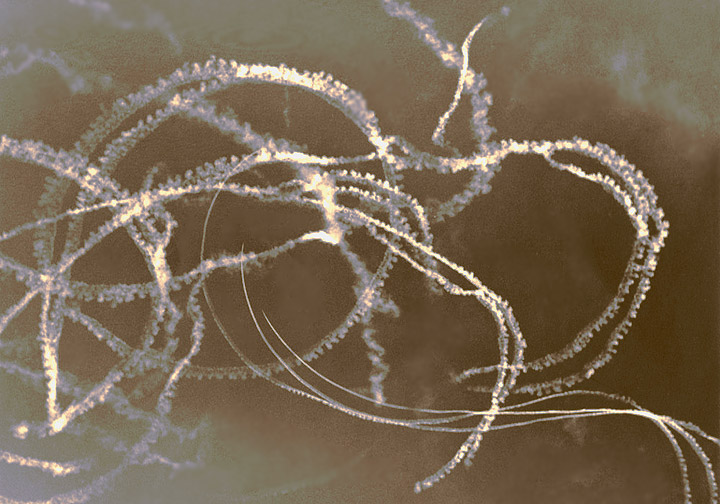
Contrails of a Sabre dogfight in European skies, 1962. Combat usually takes place below 30,000 feet and subsonic speed. The object is to turn inside the other guy to get a shot at him.
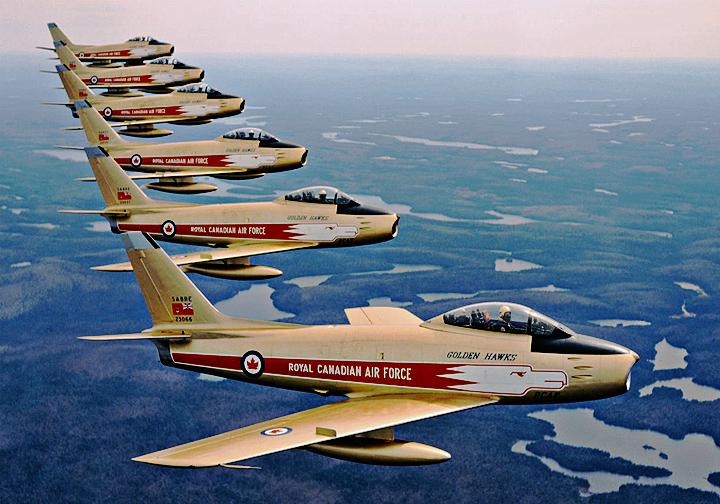
The Golden Hawks
The RCAF had several crack formation teams flying the Sabre, including the Fireballs and the Sky Lancers, but the Golden Hawks were the best known by far. Of course, the Golden Hawks had to have the same gold paint that Labatts had on their beer trucks in the 1950s. This is the 1959 team flying Mark 5s, but eventually they got the ultimate Mark 6 model.
Canadair Sabre Mark 6
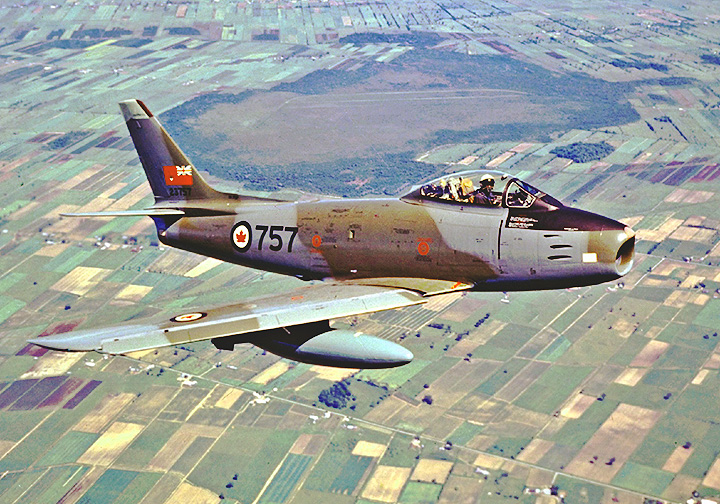
The leading edge slats were brought back on the Mark 6, lowering the stalling speed to just 110 mph. Power was increased again to 7,500 lbs. st with the Orenda 14 engine. Top speed was now 711 mph, rate of climb and ceiling improved as well. Range with 200 gal. drop tanks was 1,487 miles. The Mark 6 became available in 1955, quickly replacing the Mark 5s in NATO service. For the next few years the Sabre Mark 6 proved to be the best all-around day fighter in the air.
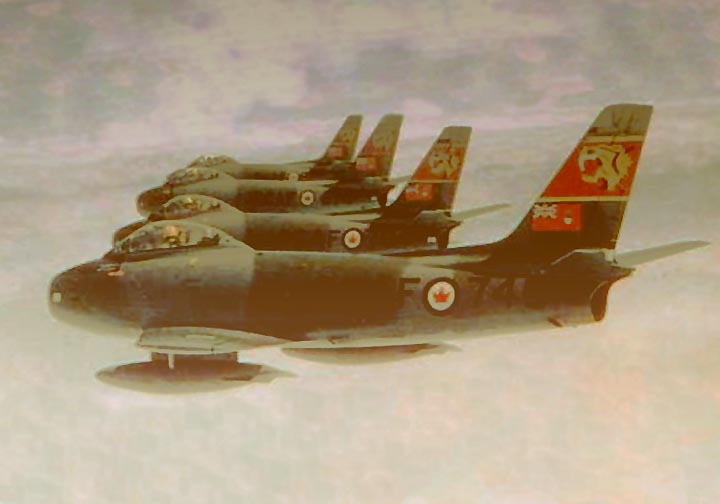
RCAF NATO No. 1 Air Division
A tight formation of Sabre Mark 6s from No. 439 “Sabre-Toothed Tiger” Sqn., RCAF, 1 Air Div., based at Marville, France until 1963. The RCAF got 390 Mark 6s (CL-13Bs) of the 655 built.
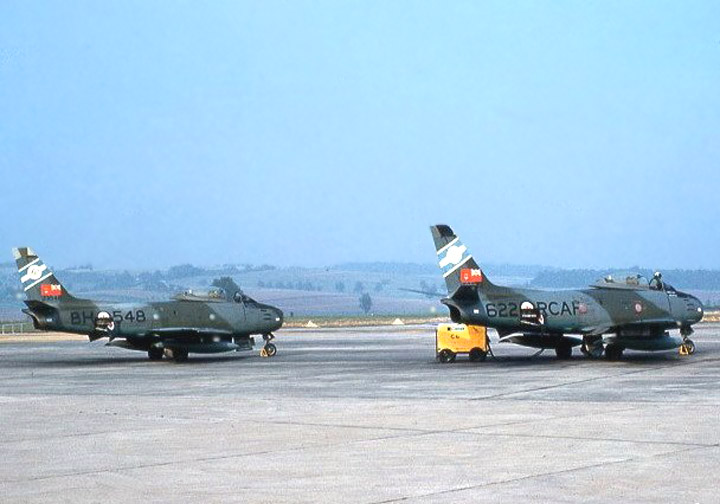
Zulu Alert
Sabre Mark 6s of 430 “Falcon” Sqn., RCAF 1 Air Division, on Zulu Alert at Grostenquin, France, in the early 1960s. Two Sabres were kept on 24 hour standby and could be airborne in minutes. One pilot said that when he was assigned Zulu duty on Christmas day they brought a turkey dinner out to him in the cockpit, but he was ordered to take off immediately. He said the turkey dinner was yanked away like it was on a string.
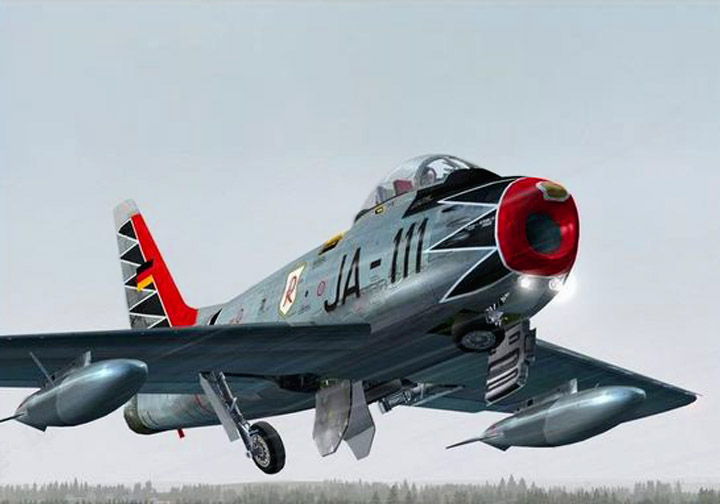
Luftwaffe Mark 6 Sabres
The Luftwaffe’s four Sabre Squadrons also upgraded to the Mark 6, receiving 225 from 1955 to 1958. This is Eric Hartmann’s Sabre from the famous JG 71 “Richtofen” taking off from Ahlhorn in 1960. Hartmann, commander of JG 71, was the all time greatest ace with an astonishing 352 victories in WW II.
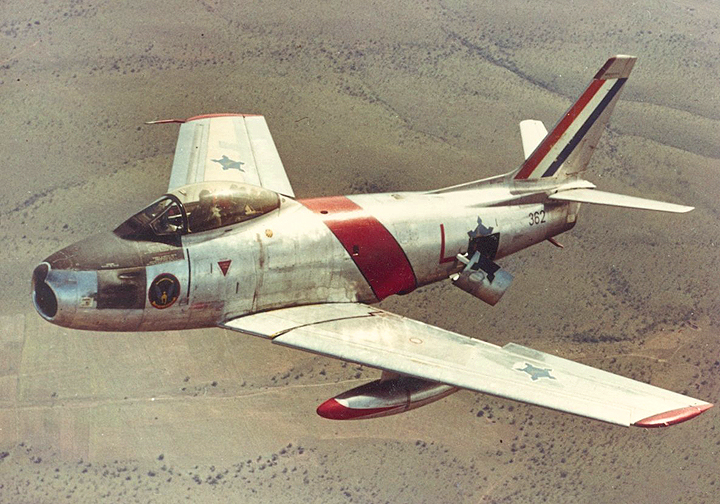
SAAF Mark 6 Sabres
The South African Air Force (SAAF) operated 34 Sabre Mark 6s until 1980.
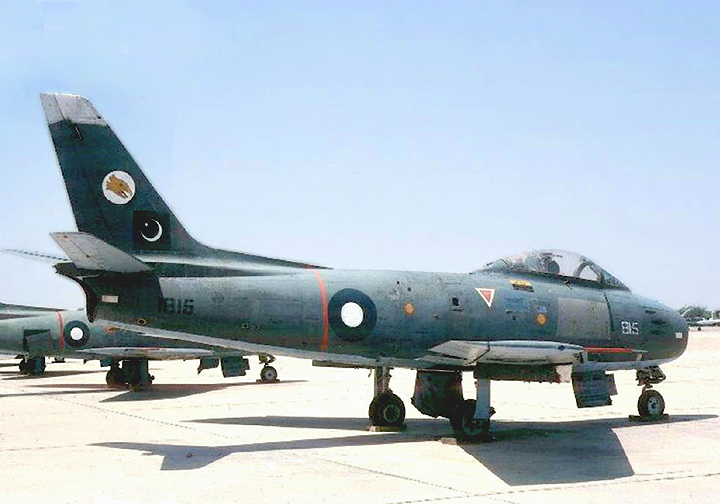
PAF Mark 6 Sabres
The Pakistan Air Force obtained 90 superbly maintained ex-Luftwaffe Sabre 6s by 1966, enough to equip four squadrons, in a deal brokered by the Shah of Iran. Apparently for diplomatic reasons, the aircraft were called F-86Es, which they obviously were not. In the Indo-Pakistani wars, the outnumbered Sabres consistently defeated Indian Air Force Hunters, Canberras, Su-7s and even MiG-21s.
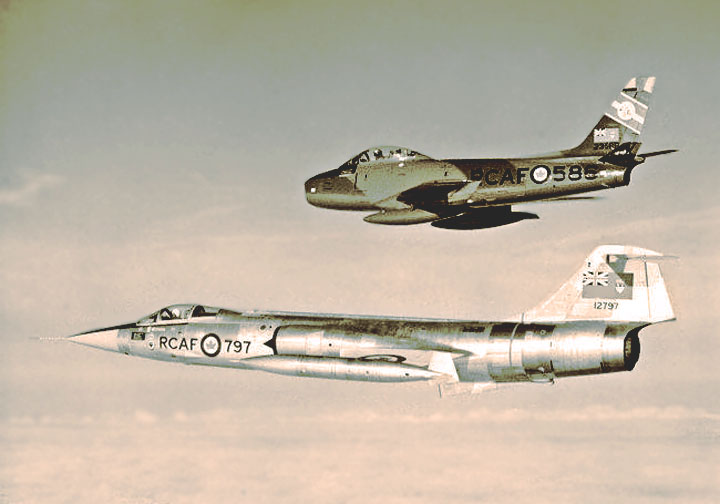
Canadair CF-104 Starfighter
The CF-104 (same as the Lockheed F-104G) began replacing the RCAF Sabres in NATO service in 1962 – 1963, about the same time as the Luftwaffe. The Starfighter was twice as fast (up to 1,450 mph), could fly higher, and had radar, but with those small wings lacked the agility of the Sabre. The new role for the RCAF CF-104s in NATO would be strike-reconnaissance. The era of the classic dogfighter was apparently over, or was it?
 Canadair Sabre Mark 1-6